About the Faculty
OVERVIEW
Faculty of Engineering and Technology (FET) was established as Faculty of Engineering (FE) in 1988 in NDA before it was renamed Faculty of Engineering and Technology in 2019. It commences activities in September 1989 with the 1989/1990 Academic Session comprising of two Departments, namely, Department of Electrical Electronics Engineering and Department of Mechanical Engineering. Thereafter the Department of Civil Engineering was also established in 1997.The Faculty later saw the need to move a step further in line with global trend and need for modern type of equipment that operate Semi-Autonomous with minimum human intervention and Autonomous without human interference which are referred to as Mechatronics Systems established in Mechatronic Engineering Department in the year 2000. Since its inception, the Faculty has lived up to its mandate, which is to impart to the Officer Cadets, required knowledge, skills and values in Engineering and Technology, also to mold their character and to use such skills for the benefit of the Armed Forces of the Federal Republic of Nigeria, Nigerians and world at large. The Faculty in 2007 also started a Postgraduate programme at the Postgraduate Diploma (PGD), Master’s of Engineering (M.Eng) and Doctorate (PhD) degrees levels. The Faculty also started Professional Master’s degrees programmes in all the Departments of the Faculty starting with Mechanical Engineering Department in 2018 and followed by Civil, Electrical Electronic and Mechatronic Engineering Department.
ADMINISTRATION
The Faculty is headed by the Dean of the Faculty who oversees the daily administration of the Faculty. The Departments are headed by Heads of Department, who are directly responsible to the Dean of the Faculty.
ENTRY REQUIREMENT
The duration of training in NDA is five (5) years. Four years for Academic study and one (1) year for full military training including attachment in relevant Engineering Departments of the military to gain practical experience.
The first year of the degree programme is spent in the Faculty of Science while taking few of Faculty of Engineering and Technology courses and the remaining three (3) years are spent in the Faculty of Engineering and Technology.
DURATION
The entry requirement for admission into NDA undergraduate programmme is 5 credits at O’level including Mathematics and English Language at not more than two sittings. Also a candidate must be medically and physically fit. In addition, cut-off score for JAMB is 210 points. Admission for Postgraduate studies is minimum of Second Class Lower Degree or Higher National Diploma with Postgraduate Diploma for Master’s and master’s degree with minimum of 3.5 on the scale of 5.0 for Doctorate degrees. For Postgraduate Diploma courses the candidate is required to have First Degree with a Third Class or HND with lower credit in relevant discipline.
Departments

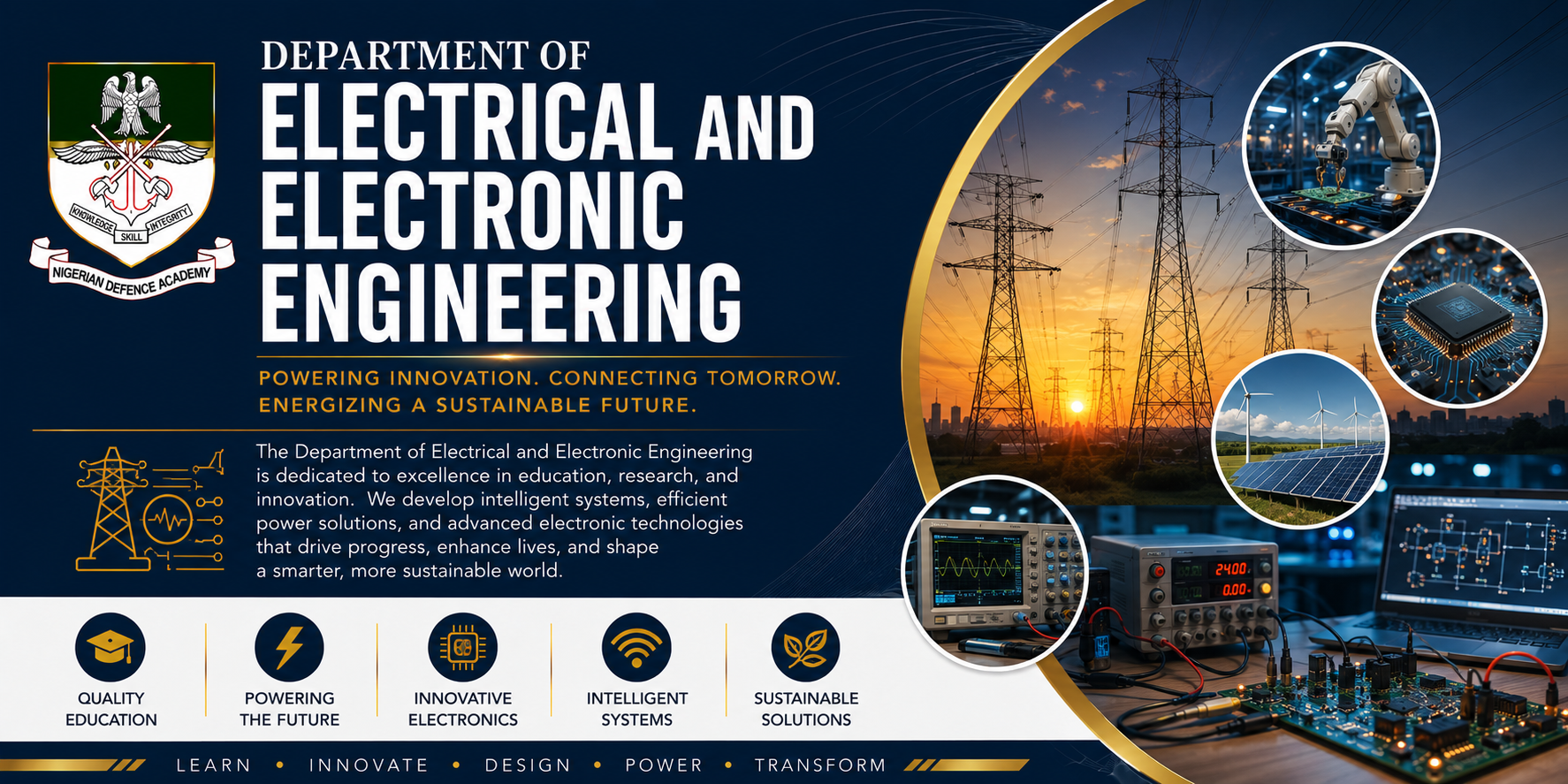
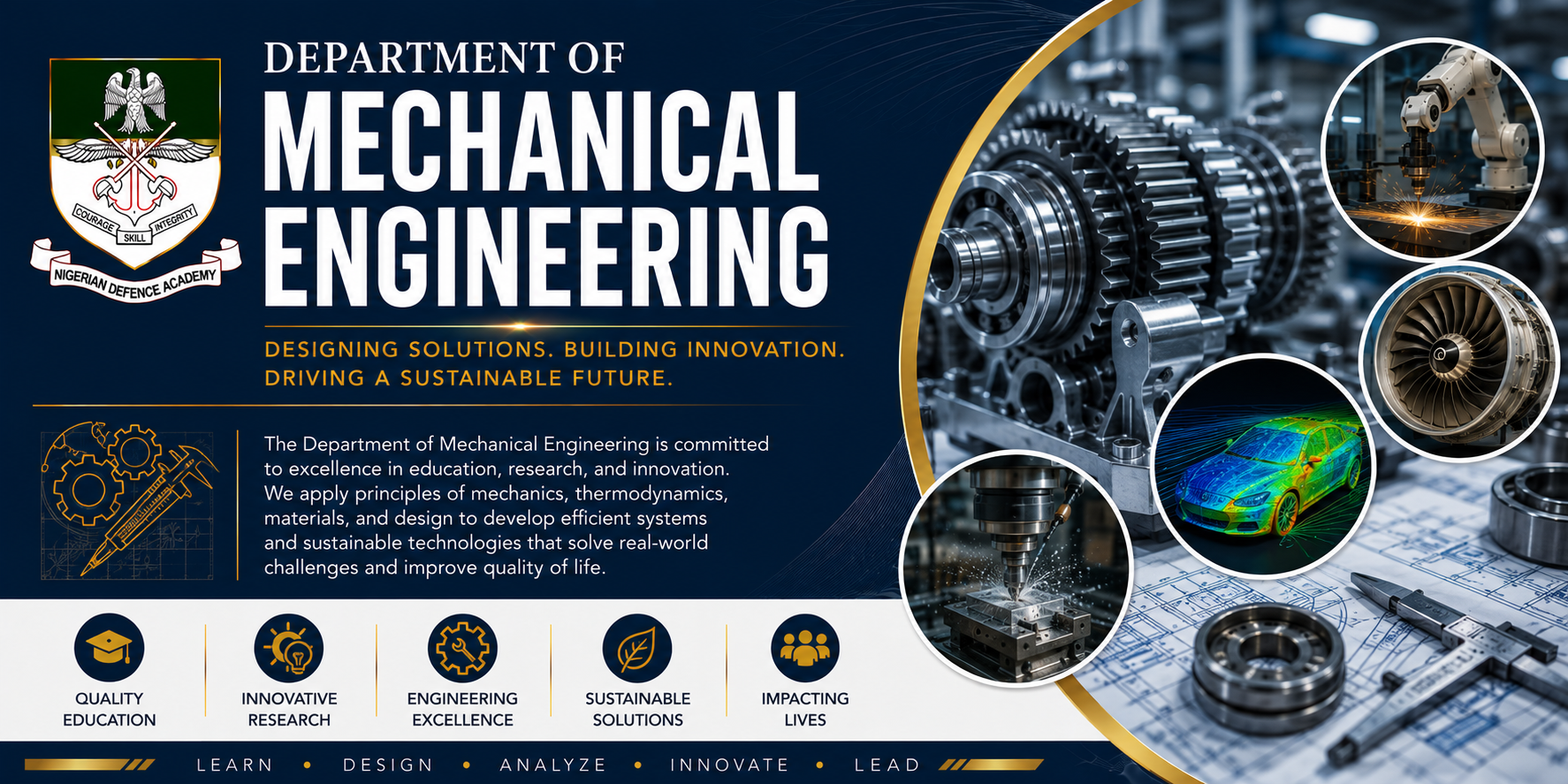
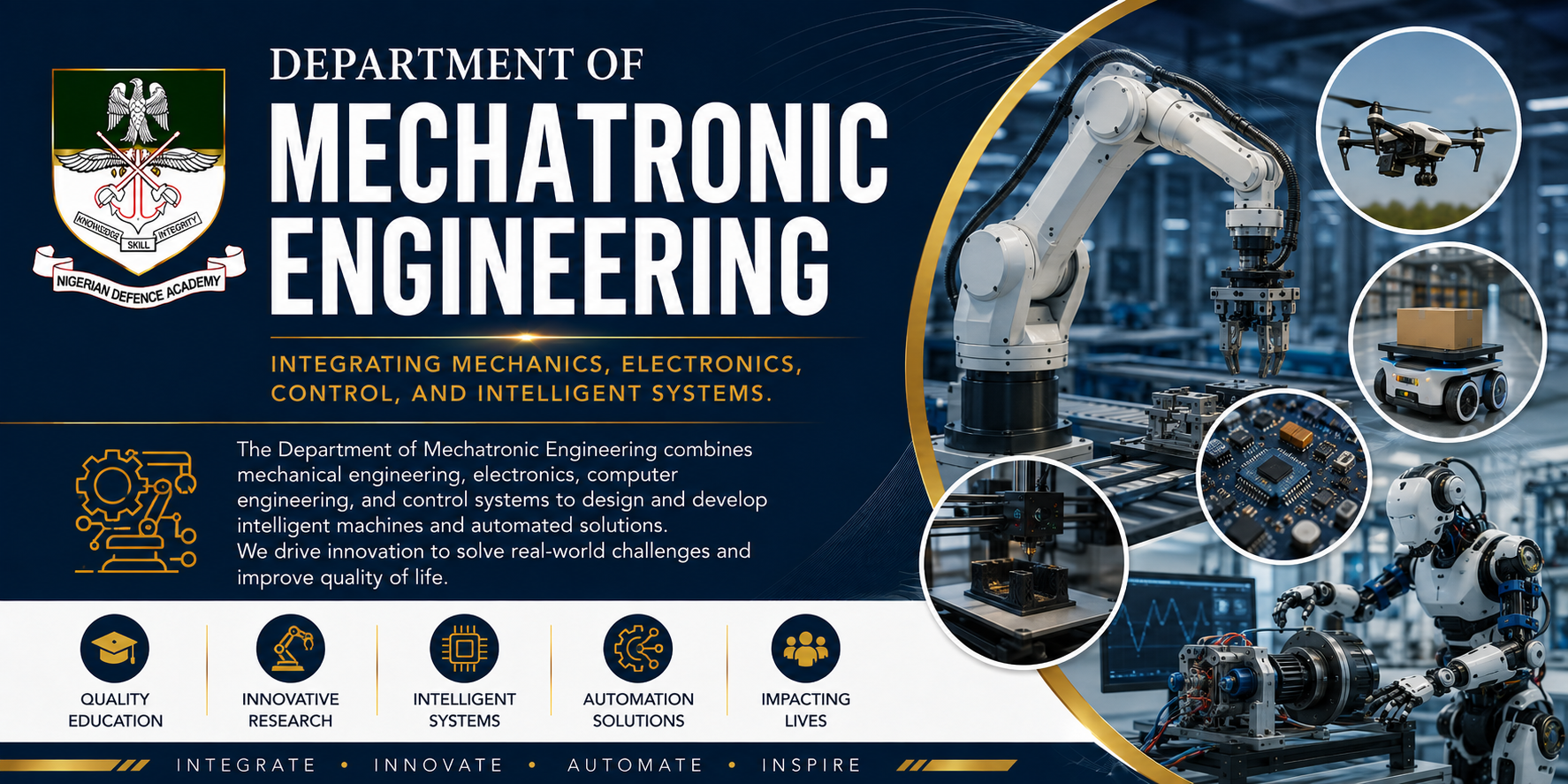
Programmes Offered
B. Eng Civil Engineering
B. Eng Electrical/Electronic Engineering
B. Eng Mechanical Engineering
B. Eng Mechatronic Engineering
The Faculty of Engineering and Technology offers PGD, Masters and PhD is several disciplines and sub-disciplines in its departments
Facilities
The Faculty of Engineering and Technology (FET) at the Nigerian Defence Academy features specialized, dual-purpose infrastructure tailored to both standard engineering disciplines and military-technical applications. Its facilities and laboratories focus on key academic and research areas:
1. Mechatronics & Robotics Laboratory Hubs
- Centre for Innovation and Creativity: A specialized facility that drives advanced prototyping. It features resources for developing autonomous systems, including unmanned ground vehicles (UGVs) and mine-clearing/de-mining military robots designed for hazardous field environments.
- Automation & Control Lab Equipment: Equipped with automation trainers, pick-and-place cobot systems, and programmable logic controller (PLC) modules to train cadets in intelligent systems engineering and tactical sensor networks.
2. Electrical & Electronics Engineering Infrastructure
- Power Systems Simulation and Testing Facilities: Laboratories explicitly configured for modeling power grid stability, rotor angle assessments, and transient voltage regulation. It hosts computer-aided simulation environments (such as MATLAB/Simulink platforms) to research smart damping grids and automated system components.
- Telecommunications Laboratory: Features instrumentation for high-frequency testing, cognitive radio networks, and electronic defense infrastructure simulation to prepare officers for electronic warfare scenarios.
3. Mechanical & Production Engineering Facilities
- Heavy Machinery and Workshops: Traditional and CNC (Computer Numerical Control) machine shops where cadets learn the fundamentals of fabrication, metallurgy, and weapons-component prototyping.
- Thermodynamics & Fluids Lab: Houses wind tunnels, fluid flow loops, and internal combustion engine testing beds to support curriculum tracks in aeronautical propulsion and land-vehicle thermodynamics.
4. Civil Engineering & Environmental Labs
- Structures and Materials Testing Lab: Equipped with high-capacity hydraulic press systems to evaluate concrete strength, soil mechanics, and structural load-bearing limits. These facilities support advanced coursework and professional tracks in construction management and specialized structural integrity.
- Geotechnics & Hydrology Labs: Tailored to surveying and civil defense infrastructure design, focusing on fortifications, bridge architecture, and heavy transportation corridors.
Research Focus Areas
The Faculty of Engineering and Technology (FET) at the Nigerian Defence Academy shapes its research around a critical dual mission: advancing standard industrial engineering frameworks while directly pioneering tactical, sovereign defense technologies for the Armed Forces of Nigeria. The faculty’s core research focus areas are structured across its primary departments:
1. Mechatronic Engineering & Autonomous Systems
Bridging computational intelligence with mechanical systems, research in this domain focuses heavily on localized defense innovations and robotics:
- Military Robotics & Unmanned Systems: Development of AI-driven tactical systems, including unmanned ground vehicles (UGVs), mine-clearing hardware, and autonomous tactical robotic counter-measures.
- UAV & Surveillance Engineering: Research into unguided munition precision controls, edge-fusion sensor grids for real-time intelligence gathering, and specialized portable launch systems designed for modern theater requirements.
- Industrial Automation & Logic Controls: Implementation of smart automation tracking, cobot (collaborative robot) systems, and programmable logic controller (PLC) engineering for secure industrial and military installations.
2. Electrical & Electronics Engineering
Research here targets secure communication links, signals processing, and national/tactical energy security:
- Power Systems Stability & Analysis: Advanced modeling and simulation of electrical grids, specializing in smart grid dampening, transient voltage regulations, and the deployment of Flexible AC Transmission Systems (FACTS).
- Electronics & Communications Engineering: Focus on high-frequency communication, digital signal processing, cognitive radio networks, and secure communication architectures resilient against electronic warfare tactics.
- Renewable Energy Integration: Exploring microgrid reliability, renewable power generation auditing, and alternate energy systems optimized for isolated deployment or field bases.
3. Mechanical Engineering
Focusing on physical propulsion, manufacturing capabilities, and thermal dynamics:
- Thermofluids & Energy Systems: Applied research using Computational Fluid Dynamics (CFD) simulation, industrial thermodynamics, and internal combustion parameters tailored for heavy transportation and aerospace propulsion tracking.
- Production & Metallurgy Prototyping: Advanced manufacturing methodologies, CNC programming, and materials characterization to assist local manufacturing pipelines (such as weapons-component prototyping alongside DICON).
4. Civil Engineering
Providing structural and spatial analysis to bolster national critical infrastructure and military civil defense:
- Geotechnical Engineering & Soil Mechanics: Analysis of soil load-bearing dynamics and foundation resilience, essential for heavy fortifications, tactical transportation corridors, and structural engineering in varying terrains.
- Structures & Concrete Technologies: Research into building materials, concrete durability, and structural analysis to optimize cost-effective, high-durability civilian and defensive infrastructure.
- Water Resources & Environmental Engineering: Hydrology modeling, environmental impact assessments, and sustainable water management systems for installations and regional development.
Key Achievements
1. Historical Military Academic Milestones
- First Serving Army Professor: The faculty made history when Lt. Col. Abubakar-Surajo Imam was promoted to Professor of Mechatronics Engineering, making him the first-ever serving personnel in the history of the Nigerian Army to attain the rank of full professor. He went on to head the Mechatronics Engineering department and spearhead the establishment of the NDA's Centre for Innovation and Creativity.
2. Specialized Defence & Robotics Research
- Autonomous & Tactical Prototyping: Faculty researchers have actively published and developed functional military-civil hardware prototypes, including AI-driven autonomous firefighting robots, pick-and-place automated cobot systems, and unguided munition precision enhancements using fuzzy logic controls.
- UAV & Surveillance Systems: Researchers within the faculty have continuously contributed to local drone technology and tactical infrastructure, designing edge-fusion sensor grids for long-range target acquisition and portable elastic-energy rail-launchers tailored for runway-independent UAV deployments in regions like the Sahel corridor and the Lake Chad Basin.
3. Curriculum Expansion & Technological Infrastructure
- Pioneering Mechatronics Education: FET successfully expanded its traditional engineering lines (Civil, Electrical/Electronics, Mechanical) to establish a dedicated, cutting-edge Mechatronics Engineering department. This program bridges hardware control with software intelligence to support Nigeria's growing modern military architecture.
- Advancing the Military-Industrial Complex: Through its specialized research and development hubs, the faculty acts as a core technical driver for local innovation partners like the Defence Industries Corporation of Nigeria (DICON) and the Defence Research and Development Bureau. These partnerships focus on engineering novel hardware and software solutions to reduce national dependence on foreign technical assets.
4. Contributions to Power Systems and National Infrastructure
- Power Grid Stability Research: The faculty's electrical engineering researchers actively publish advanced simulations aimed at enhancing national infrastructure, such as designing robust damping controllers utilizing Flexible AC Transmission Systems (FACTS) like STATCOM alongside power system stabilizers (PSS) to stabilize multi-machine power grids.

Dean
Engr Prof Saminu Ahmed
Faculty of Engineering and Technology
Dec 2024 — Present
View Full Profile